Why CANNs?
Estimated Reading Time: 8 minutes
Target Audience: Experimental neuroscientists, computational neuroscientists, AI researchers, engineers, and students interested in attractor networks
The Challenge: Modeling Continuous Neural Representations
How does your brain know where you are in a room? How do hippocampal and entorhinal neurons maintain stable representations of your position, head direction, and navigation path—even without external cues? These questions probe the core mechanisms of continuous attractor dynamics in neuroscience.
Traditional neural networks process discrete inputs and outputs. In contrast, the brain handles continuous state spaces—position, orientation, speed, and other variables that change smoothly over time. CANNs offer a computational framework for understanding how neural populations encode, maintain, and update these continuous representations through stable activity patterns called “attractors.”
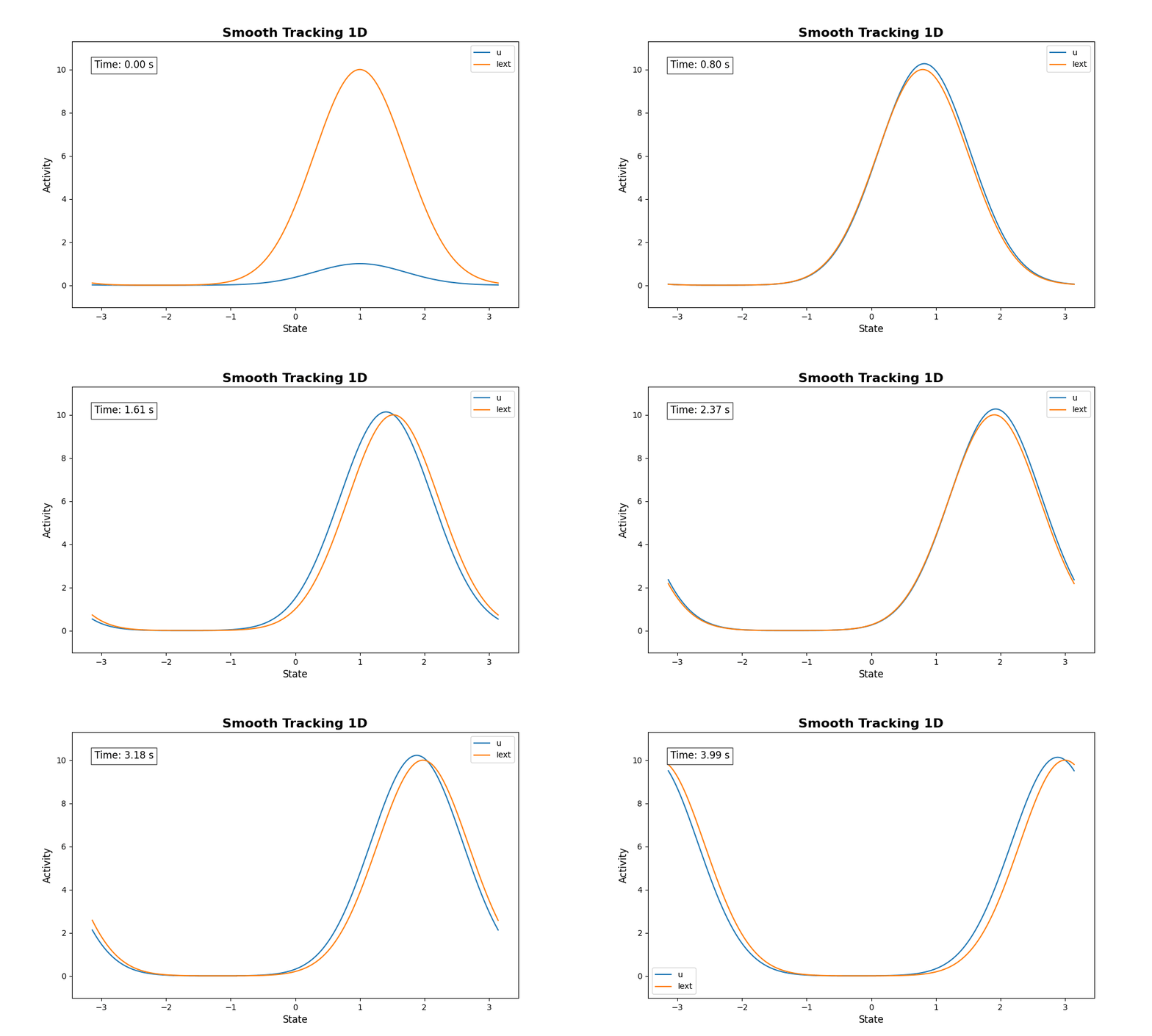
A 1D CANN tracking a smoothly moving stimulus, demonstrating stable bump dynamics
Despite decades of theoretical progress, applying CANNs remains challenging:
No standardized implementations – researchers build models from scratch for each study
Fragmented tools – task generation, model simulation, and analysis require different codebases
Reproducibility barriers – comparing results across studies is difficult without shared infrastructure
Steep learning curve – students must implement complex dynamics before exploring ideas
This is where the CANNs library comes in.
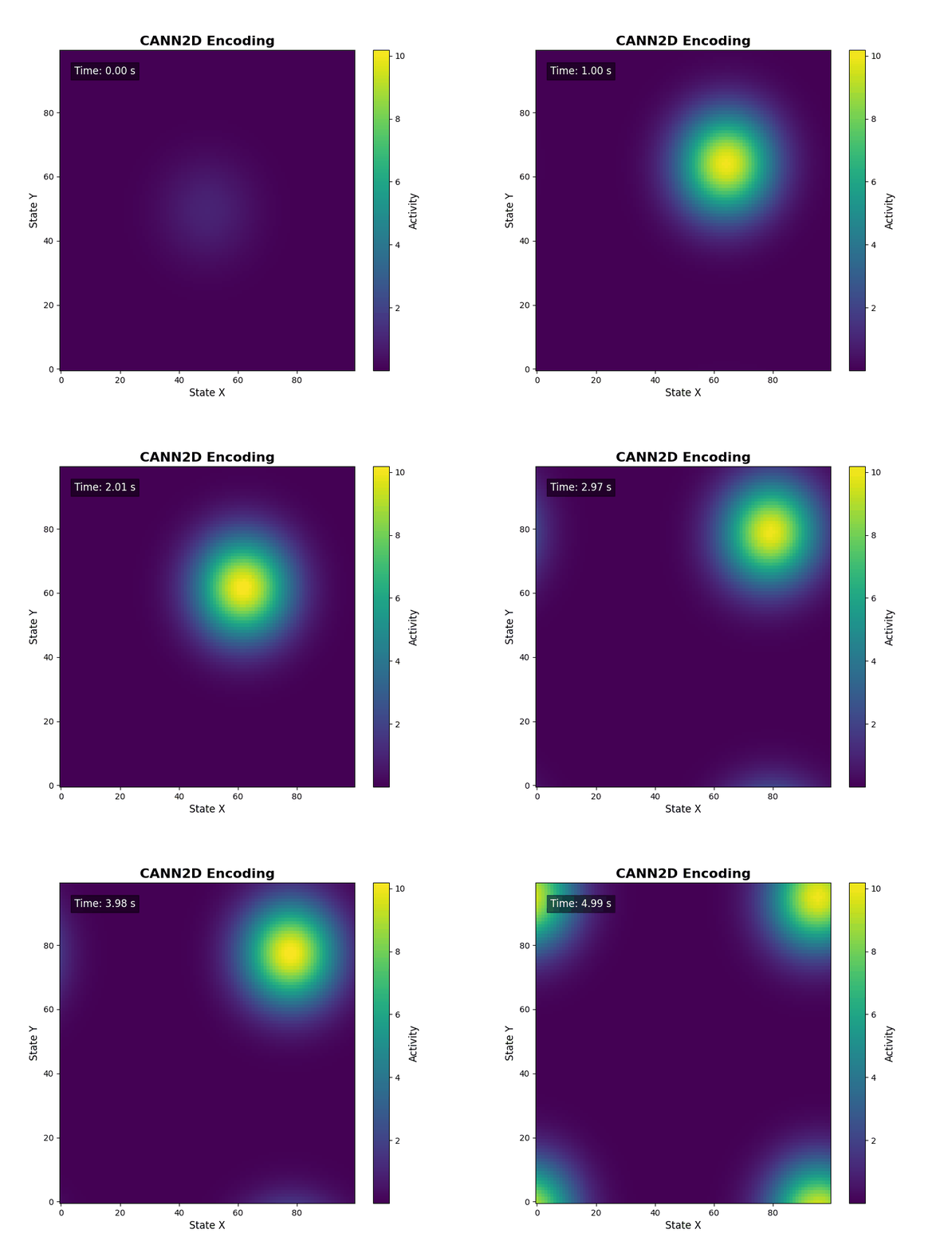
2D spatial encoding patterns in CANN networks
What Makes CANNs Special?
Continuous Attractor Neural Networks possess unique properties that bridge neuroscience and AI:
Stable Continuous Representations
CANNs naturally maintain stable activity patterns (attractors) across continuous state spaces. Unlike Recurrent Neural Networks (RNNs) that require careful tuning, CANNs rest on strong theoretical foundations that ensure stability—activity bumps persist without external input, enabling short-term memory and robust encoding.
Brain-Inspired Dynamics
Compared to attention-based models like Transformers, CANNs operate through mechanisms closer to biological neural circuits. They excel at modeling:
Continuous State Space Processing
Traditional deep learning models discretize the world. CANNs process continuous variables natively—matching how brains handle smooth changes in position, orientation, and sensory stimuli.
Path Integration and Navigation
CANNs perform path integration naturally [4]: they integrate velocity signals over time to track position without external landmarks—a core computation in rodent navigation and human spatial cognition.
The CANN models in this library are primarily based on the mathematically tractable and canonical continuous attractor neural network called the Wu-Amari-Wong (WAW) model [5, 6, 7, 8]. This canonical model provides an elegant theoretical framework for understanding continuous attractor dynamics, and its mathematical tractability enables researchers to deeply analyze network stability, dynamical properties, and encoding capabilities.
In addition to guiding users through the implementation of the WAW model, this library also demonstrates how to implement a torus grid cell model with a donut-like topology.
Building on this theoretical foundation, a recent advance combined CANNs with neural adaptation (A-CANN) [9, 10] to explain diverse hippocampal sequence replay patterns during rest and sleep [11]. By introducing adaptation—a universal neural property—as a single control variable, researchers unified seemingly disparate phenomena: stationary replay, diffusive sequences, and super-diffusive sweeps.
This work demonstrates CANN’s power: simple, biologically plausible mechanisms can explain complex neural dynamics with profound implications for memory encoding and retrieval.
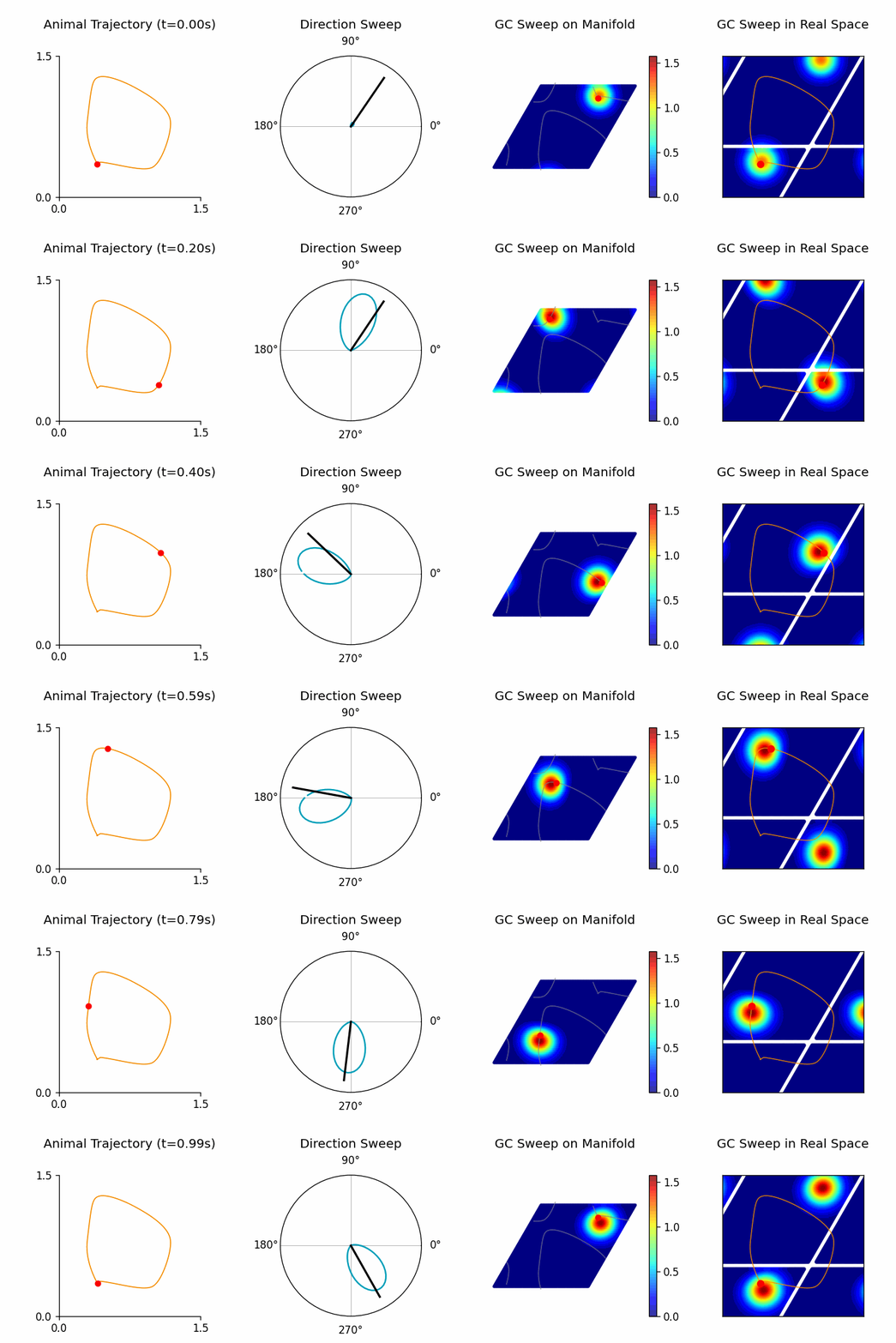
Theta sweep dynamics in grid cell and head direction networks
Who Should Use This Library?
The CANNs library serves three main communities:
🔬 Experimental and Computational Neuroscientists
Continuous attractor networks are gaining traction in systems neuroscience. Researchers want to:
Analyze experimental data for attractor signatures
Build CANN models to validate hypotheses against neural recordings
Reproduce and extend published CANN studies efficiently
🛠️ Engineers & Developers
As CANNs mature, they require standardized development practices—similar to how Transformers revolutionized NLP with consistent APIs and shared infrastructure. Engineers need unified tools to:
Implement bio-inspired navigation and memory systems
Benchmark CANN architectures systematically
Deploy CANN-based applications in robotics and AI
🎓 Students & Educators
Learning CANNs shouldn’t require implementing complex dynamics from scratch. Students benefit from:
Ready-to-use models for hands-on exploration
Clear examples demonstrating key concepts
Modifiable code to experiment with parameters and architectures
Without standardized tools, each group reinvents the wheel. The CANNs library changes that.
Key Application Scenarios
1. CANN Neural Computational Modeling
Take theta sweep modeling and analysis as an example.
The Challenge: Hippocampal neurons exhibit rich sequential firing patterns during rest and sleep—stationary, diffusive, and super-diffusive—with important cognitive functions. Understanding these “theta sweeps” [12] is central to memory research.
The Solution: The A-CANN framework (CANN + neural adaptation) [9, 10] explains these diverse patterns through a single variable. This library provides:
Pre-built models:
HeadDirectionNetwork[13] ,GridCellNetwork[11] ,PlaceCellNetwork[14],Specialized visualization: Theta sweep animation and analysis tools
Reproducible pipelines:
ThetaSweepPipelineorchestrates simulation, analysis, and plotting
Impact: Researchers can immediately build on this work without reimplementing models and analysis tools.
2. Education and Research Training
The Challenge: Teaching CANNs traditionally requires students to implement models from scratch each semester, consuming weeks that could be spent on scientific exploration.
The Solution: With this library, students can:
Instantiate CANN models in 3 lines of code
Generate task data (smooth tracking, population coding) with minimal setup
Visualize dynamics with built-in analysis tools
Impact: Students now focus on understanding mechanisms rather than debugging implementations.
3. High-Performance Simulation
The Challenge: Long simulations and large-scale experiments (e.g., parameter sweeps, topological data analysis [15, 16]) are computationally expensive.
The Solution: The companion canns-lib Rust library provides:
700× speedup for spatial navigation tasks vs. pure Python (RatInABox-compatible API)
1.13× average, 1.82× peak speedup for topological analysis (Ripser algorithm)
Perfect accuracy – 100% result matching with reference implementations
Impact: What once took hours now runs in minutes. Researchers can explore parameter spaces and analyze datasets at scale.
Simulation Steps |
Pure Python |
canns-lib (Rust) |
Speedup |
|---|---|---|---|
10² |
0.020 s |
<0.001 s |
477× |
10⁴ |
1.928 s |
0.003 s |
732× |
10⁶ |
192.775 s |
0.266 s |
726× |
Why This Library? The Unified Ecosystem Advantage
The Problem: A Fragmented Landscape
Currently, CANN research resembles NLP before Transformers—each lab uses custom code, diverse implementations, and incompatible formats. This fragmentation causes:
Reinvention overhead: Researchers repeatedly re-implement basics
Reproducibility issues: Comparing studies requires reverse-engineering code
Slow progress: No shared models, benchmarks, or best practices
The Vision: CANNs as the “Hugging Face Transformers” of Attractor Networks
Just as Hugging Face standardized Transformer usage, the CANNs library aims to unify CANN research:
Standardized Model Zoo
Unified Task API
Smooth tracking, population coding, closed/open-loop navigation
Import experimental trajectories directly
Consistent data formats across tasks
Complete Analysis Pipeline
Energy landscapes, tuning curves, firing fields, spike embeddings
Topological data analysis (UMAP, TDA, persistent homology)
Theta sweep and RNN dynamics analysis
Extensible Architecture
Base classes (
BasicModel,Task,Trainer,Pipeline) for custom componentsBuilt on BrainPy [18] for JAX-powered JIT compilation and autodifferentiation
GPU/TPU acceleration out of the box
Community & Sharing
Open-source foundation for model and benchmark sharing
Unified evaluation protocols
Growing ecosystem of examples and tutorials
Technical Foundations
What makes this library powerful?
🚀 Performance Through BrainPy + Rust
BrainPy integration [18]: High-level dynamics API with JAX’s JIT compilation, automatic differentiation, and GPU/TPU support
canns-lib acceleration: Rust-powered hot paths for task generation and topological analysis
Efficient compilation: Write models in simple Python, run at C++ speeds
🧩 Comprehensive Toolchain
Models: 1D/2D CANNs, hierarchical networks, SFA variants, brain-inspired models
Tasks: Tracking, navigation, population coding, trajectory import
Analyzers: Visualization, TDA, bump fitting, dynamics analysis
Trainers: Hebbian learning, prediction workflows
Pipelines: End-to-end workflows (e.g., theta sweeps) in single calls
🔬 Research-Grade Quality
Validated implementations: Models reproduce published results
Comprehensive testing: Pytest suite covering key behaviors
Active development: Regular updates, bug fixes, community contributions
Current Status & Future Directions
Development Stage: The library has been under active development for 4 months and is currently in beta (v0.x). It is being used internally by our research group, and we’re actively expanding features based on user feedback.
Validation:
✅ Models reproduce established CANN behaviors
✅ Performance benchmarks show significant speedups (canns-lib)
✅ Growing collection of working examples across models and tasks
Roadmap:
Expand brain-inspired model collection (recurrent networks, spike-based models)
Add hybrid CANN-ANN architectures
Develop comprehensive benchmarking suite
Build community-contributed model zoo
Publish companion paper documenting library design
Limitations (we believe in transparency):
Beta software – APIs may evolve based on feedback
Documentation is actively expanding (your contributions welcome!)
Limited pre-trained models currently (we’re building this out)
Smaller community compared to mature deep learning frameworks (but growing!)
Next Steps: Dive In!
Quick Start
Ready to build your first CANN? Jump to our Quick Start Guide for a hands-on walkthrough in <10 minutes.
Learn More
Core Concepts: Understand the library’s design philosophy
Basic Tutorials: Step-by-step guides for common tasks
Full API Documentation: Complete reference for all models and methods
Examples Gallery: Ready-to-run scripts demonstrating key features
Get Involved
🐛 Report issues: GitHub Issues
💬 Ask questions: GitHub Discussions
🤝 Contribute: Check our Contributing Guide
⭐ Star the repo: github.com/routhleck/canns
Have questions or suggestions for this documentation? Open an issue or discussion on GitHub !